top of page


Work scene
The beauty exists on being particular about quality.
Firstly
~Solitude is the best environment for self-improvement.~
My engraving room is located under the stairs in a corner of the office. Day after day, I work quietly, hardly ever seeing anyone. However, I feel that it is precisely this environment—which could be called “solitude”—that has helped me grow.
Only in solitude have I found the freedom to create without comparison, and the courage to pursue ideas that are entirely my own. I believe that the farther we quietly walk our own path, the closer we come to discovering who we truly are.

彫金部屋
四畳ほどの小部屋です。
彫金部屋
四畳ほどの小部屋です。
1/1
1. Sketch
~The World is full of things worth engraving.~
What shall I engrave next? – I ask myself this question everyday.
Sometimes I draw inspiration from Japanese cultural heritage, the changing seasons, the beauty of nature, or the character of animals.
Each engraving begins in my notebook, where I sketch out each design with a pencil. I devote myself to capture every detail – contours of lana dscape, subtle expression of an animal, delicate petals of flowers. From this I add colours to explore depth, texture and play of light before translating the image onto steel.
Once the vision is clear, I pick up the hammer and chisel. I let my hands bring it to life.

デザインは100種類以上。
お蔵入りになった作品もたくさん。
デザインは100種類以上。
お蔵入りになった作品もたくさん。
1/1
2. Preparing the Tools
~My craft relies on just two tools: a hammer and a chisel.~
With every strike of the hammer, the chisel advances through the steel, carving each line by hand. While the tools themselves are simple, there are countless variations of hammers and chisels, each chosen for a specific purpose. Knowing which to use—and when—is part of a lifelong pursuit to transform imagination into steel.
My left hand guides the chisel. My right hand delivers each hammer strike. Together, they must move as one.
The beauty of an engraving lies in the harmony between both hands. Every detail is shaped by a delicate balance of force, angle, pressure, and timing. The way the chisel is held, the angle at which it meets the steel, and the strength of every hammer blow all determine the depth, texture, and character of the engraving.
To many, these are simply tools. To me, they are the means through which steel becomes an expression of craftsmanship.

鏨と金槌
さまざまな種類の鏨を使い分けます。
鏨と金槌
さまざまな種類の鏨を使い分けます。
1/1
~I make my own tools.~
A craftsman’s work is only as good as his tools. Yet, it is rare to find tools that feel exactly right for me. If they do not exist, I have only one choice – to make them myself.
I regularly make my own chisels, shaping each one to suit the way I work. From forging, sharpening to polishing and finishing, every detail is refined to my own standards.
The angle of the chisel‘s edge determines the character and width of each engraved line, while the grit of the whetstone influences the luster of the finished surface.
Only after each chisel is prepared for it‘s purpose can I finally begin my metalwork.

形成

荒研ぎ

仕上げ研ぎ
形成
1/4
荒研ぎ

平研ぎ
形成
荒研ぎ
1/4
平研ぎ
仕上げ研ぎ
荒研ぎ
平研ぎ
1/4
仕上げ研ぎ
形成
平研ぎ
仕上げ研ぎ
1/4
3. Engraving work
~Too much can be as bad as too little. ~
Engraving demands complete focus of the hands, the eyes, and the ears.
That is why I always stop before fatigue begins to dull my concentration. Every piece deserves my full attention, and every strike of the hammer must be made without compromise.
Dragon scales, tiger fur, fish scales, cherry blossom petals...
Each texture is built one strike at a time. Though a single blow may seem insignificant, it has the power to change the character of the entire work. True beauty lies in being particular about every detail.

舞妓と桜

一登竜門

風神
舞妓と桜
1/4
一登竜門

富士と夕焼
舞妓と桜
一登竜門
1/4
富士と夕焼
風神
一登竜門
富士と夕焼
1/4
風神
舞妓と桜
富士と夕焼
風神
1/4
~Get creative~

"How can I capture the softness of a bird's feathers in cold steel?"
When the tools cannot create the expression I imagine, I make a new one.
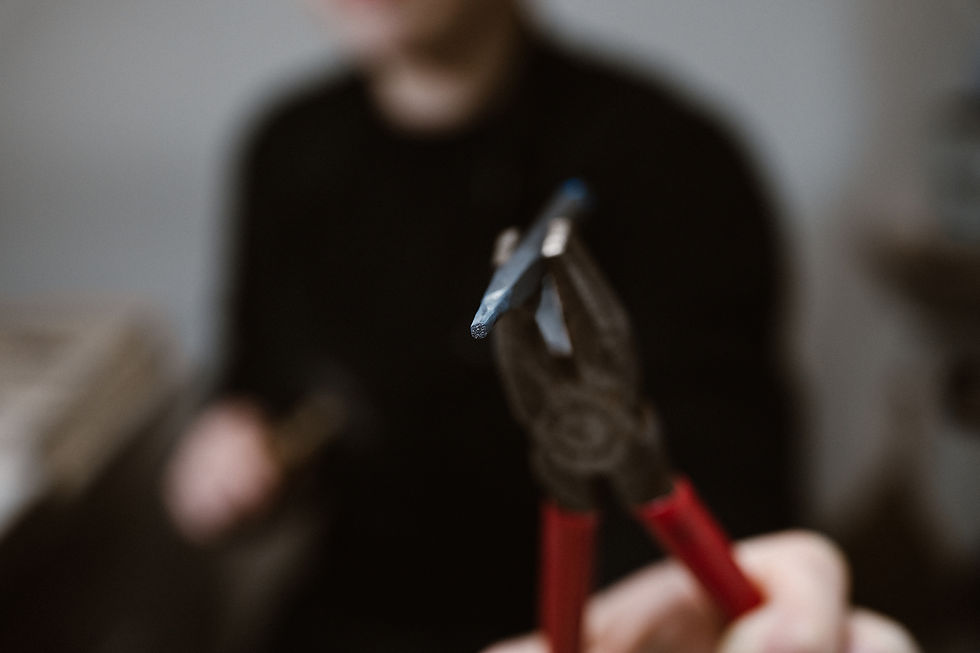
The nashiji chisel is born by heating its tip until it glows, then pressing the texture of a file into the steel. The pattern it leaves behind brings the delicate feel of a bird's feathers to life.
Not every experiment succeeds, but none are wasted. Each attempt reveals a new possibility, and every discovery becomes a technique that is uniquely my own.

梨地タガネ作り
鏨を赤くなるまで熱します。
梨地タガネ作り
ヤスリ棒の荒目を焼き付けます。

梨地タガネ作り
梨地タガネ作り
鏨を赤くなるまで熱します。
1/3
梨地タガネ作り
ヤスリ棒の荒目を焼き付けます。
梨地タガネ作り
梨地タガネ作り
鏨を赤くなるまで熱します。
梨地タガネ作り
ヤスリ棒の荒目を焼き付けます。
1/3
梨地タガネ作り
梨地タガネ作り
鏨を赤くなるまで熱します。
梨地タガネ作り
ヤスリ棒の荒目を焼き付けます。
梨地タガネ作り
1/3
~Manufacturing with Market Demand~
Loving your craft is important. But if it cannot sustain itself, it remains only a hobby. A craftsman must always balance passion with efficiency, and creativity with value.
No matter how much time or effort goes into a piece, it has little meaning if it never finds someone who wishes to own it. Craftsmanship is not measured by self-satisfaction, but by whether the work resonates with others.
A craftsman rarely knows the moment he has become accomplished. For me, each order is a quiet affirmation that my work has found its place. The trust of my customers is not only my greatest encouragement—it is the truest measure of the value of what I create.

利益重視
スピードと効率を常に意識。
利益重視
スピードと効率を常に意識。
1/1
4. Attaching a handle
~The Blade Never Lies~
Once the engraving is complete, the handle is finally fitted to the blade.
An engraved knife is prepared for display rather than used. Because it is a work of art, the harmony between the blade and the handle is just as important as the engraving itself.
Before fitting the handle, I always check the straightness of the blade. In my early years, I often struck the steel with more force than necessary, leaving the blade slightly warped. Each one had to be carefully corrected before the work was complete.
Over time, my technique changed. My hammer became lighter, my strikes more deliberate, and the blade remained true.
The straightness of the blade reflects the care with which it was engraved, and reminds me that true craftsmanship is measured not only by what is added to the steel, but also by what is left undisturbed.

柄付け
鏨を赤くなるまで熱します。

柄付け
中子を叩いて真っ直ぐに修正します。

柄付け
真っ直ぐついているか確認します。
柄付け
鏨を赤くなるまで熱します。
1/3
柄付け
中子を叩いて真っ直ぐに修正します。
柄付け
鏨を赤くなるまで熱します。
柄付け
真っ直ぐついているか確認します。
柄付け
中子を叩いて真っ直ぐに修正します。
1/3
柄付け
真っ直ぐついているか確認します。
柄付け
鏨を赤くなるまで熱します。
柄付け
中子を叩いて真っ直ぐに修正します。
柄付け
真っ直ぐついているか確認します。
1/3
5. The Final Touch
~It's just a knife box, but the feeling of gratitude to it is added.~
It is only a knife box, yet I believe it deserves the same gratitude as the work it holds.
Once the engraving is complete, I wrap the box with traditional Japanese paper. With a brush in hand, I give the piece its name, then gently place my mark upon it.
Each character is written in quiet anticipation of the moment the box is opened. It is my final wish that the person who receives the knife will feel not only the craftsmanship within, but also the gratitude with which it was made.

箱の天面制作
作品の雰囲気に合う和紙を選びます。

箱の天面制作
手書きで作品名をしたためます。

箱の天面制作
箱に貼ったら完成です。
箱の天面制作
作品の雰囲気に合う和紙を選びます。
1/3
箱の天面制作
手書きで作品名をしたためます。
箱の天面制作
箱に貼ったら完成です。
箱の天面制作
作品の雰囲気に合う和紙を選びます。
箱の天面制作
手書きで作品名をしたためます。
1/3
箱の天面制作
箱に貼ったら完成です。
箱の天面制作
作品の雰囲気に合う和紙を選びます。
箱の天面制作
手書きで作品名をしたためます。
箱の天面制作
箱に貼ったら完成です。
1/3
Lastly
~Just give it a try.~
Most of my work begins with familiar designs. Then someone asks, "Could you carve something like this?" Those are the moments that quietly stir my heart.
Some requests leave me searching for an answer for days. Yet I have never learned to say "no”. Beyond every difficult request lies a chance to become a better craftsman.
When I finally lift the hammer and chisel, doubt slowly gives way to anticipation. The thought of "Can I do this?" becomes "Let's see how far I can go."
When the final strike is made, I am left with two gifts: the quiet satisfaction of having surpassed yesterday's self, and the simple joy of working with metal. In those moments, I am reminded that this is the life I was meant to live.

彫金部屋
彫金部屋
1/1
I began as a self-taught craftsman. Everything I know has been shaped by the trust of those who placed their ideas in my hands. Their challenges became my teachers, and their smiles became my confidence.
Chance favors only the prepared mind. I focus on only to continue refining my craft. When the next one appears, I can welcome it with a hammer in one hand, a chisel in the other, and the words:
"Let's give it a try."

bottom of page